A/A* Guarantee

7 Day Money-Back
Guarantee

Home > Edgenie Sunday Schroll: Newsletter > "How to Convince Teachers to Raise Your Predicted Grades"

Welcome to the 99th edition of our Newsletter EdGenie's 📜 Sunday Scroll...

Every Sunday I send out actionable tips, tricks and real-world application insights from my 15 year experience coaching students to achieve As and A*s in their Economics A Levels via EdGenie.

Jump to Section:


"How to Convince Teachers to Raise Your Predicted Grades"

Hey Genies, 👋

How do you convince your teacher to give you higher predicted grades?

It’s not about begging. It’s not about promising to “try harder.”

Teachers don’t change predictions because of words. They change them because of evidence.

If you want an A or A*, you need to hand them undeniable proof that you are that student.

Here are 4 powerful ways to do exactly that:

1. Show you have a support system​

Teachers hesitate to predict higher if they think you’ll crumble under pressure. Show them you’re backed.

• Weekly masterclasses with examiners
• Unlimited past paper feedback
• 64% of students in the same system hitting As and A*s

This tells your teacher: “I’m not guessing anymore. I have the right guidance.”

2. Rewrite your weakest essay and hand it back​


Don’t hide your mistakes. Prove you learn from them.

Take your lowest essay, apply the feedback, rewrite it, and resubmit. Teachers respect growth they can see.

3. Submit timed work before they ask​


Don’t wait for homework.

Pick a past paper question, complete it under exam timing, and give it to your teacher unprompted.

It shows discipline, initiative, and provides new evidence they weren’t expecting.

4. Track your progress with data​


Teachers respect numbers.

Keep a record: “I went from 14/25 to 19/25 in one month.”

When they see measurable progress, it’s hard to deny you’re moving into the A/A* range.

Final Word​

Predicted grades are not fixed. But they don’t change with words. They change with consistent, undeniable proof.


Do these four things, and your teacher will have no choice but to see you as an A or A* student.

⏳ Not enrolled yet?​


Every week you miss, others are moving ahead while you stay stuck.

Don’t let yourself fall behind when the A/A* students are already inside, sharpening their exam technique.

👉 Enrol now and secure your place:


Economics (2026 exams): [Edexcel] [AQA] [OCR]​

Economics (2027 exams): [Edexcel] [AQA] [OCR]​

Maths (2026 exams): [Edexcel]​

Maths (2027 exams): [Edexcel]​

🚀 The sooner you start, the faster you rise.

Only two EVs qualify for full discount under new UK subsidy scheme

Summary

🔋 New Subsidy Scheme
UK government launched a £650mn EV subsidy scheme offering up to £3,750 off EVs priced under £37,000.

🚗 Only Two Winners
So far, only two Ford models (Puma Gen-E and E-Tourneo Courier) qualify for the full discount.

📉 Tiered System
A further 26 models (Stellantis, Renault, Nissan, VW etc.) get a smaller £1,500 subsidy, while most Chinese EVs get nothing.

🏭 Production-Based Ranking
Eligibility depends on the carbon intensity of manufacturing locations — countries with dirtier grids, like China, are penalised.

💰 Cheaper to Run
With the discount, Ford’s Puma Gen-E costs £290/month, cheaper than the petrol version at £324.

👥 Consumer Interest
Auto Trader saw demand nearly double for sub-£37,000 EVs after the announcement, though uncertainty delayed some July sales.

📈 Market Impact
EV sales rose 9.1% in July, but growth remains below the 28% target set under the UK’s EV mandate (currently 21%).

🌍 Global Reactions

Chinese firms like Leapmotor criticised the scheme as unfair, while Hyundai cut prices despite likely exclusion.

⚖️ Protectionism Debate
Critics argue the scheme is a form of green industrial policy favouring domestic/European production, sparking protectionism concerns.

A Level Economics Questions:

Q. Explain how a government subsidy can correct the underconsumption of electric vehicles.
A. A subsidy lowers the private cost of purchase, shifting the supply curve rightward from S to S+subsidy. Since EVs generate positive externalities such as reduced pollution and improved air quality, they are underconsumed at the free-market equilibrium (Qm). The subsidy reduces the market price, increasing consumption toward the socially optimal level (Qs), thereby internalising the external benefit. This improves allocative efficiency because the external benefits are now reflected in the market outcome. In the UK case, a £3,750 subsidy encourages more consumers to buy EVs, narrowing the gap between marginal private benefit and marginal social benefit.

Q. Analyse how the UK’s £3,750 EV subsidy is likely to affect the demand curve for electric vehicles priced under £37,000.

A. A subsidy effectively lowers the price paid by consumers, shifting the effective demand curve outward (D to D1). For EVs under £37,000, this makes models like Ford Puma Gen-E relatively cheaper compared to petrol alternatives. As the price falls from P1 to P2, the quantity demanded rises from Q1 to Q2. Since demand for EVs is likely to be price elastic at lower price ranges, the extension in demand could be significant. Auto Trader’s doubling of interest in cheaper EVs provides evidence of high responsiveness. However, uncertainty about eligibility criteria temporarily dampened demand, showing that policy clarity also influences consumer confidence.

Q. Evaluate whether subsidies are the most effective policy to increase electric vehicle adoption in the UK

A. Subsidies lower consumer prices, correcting market failure caused by positive externalities and encouraging EV adoption. They also support domestic producers, creating jobs and growth. However, subsidies are costly (£650mn fund) and only two models qualify fully, limiting their reach. Alternative policies may be more effective: investment in charging infrastructure reduces range anxiety, while regulation such as the 2035 petrol ban ensures long-term adoption. Moreover, subsidies risk government failure if they distort competition or favour domestic over foreign firms, reducing efficiency. In judgement, subsidies can be effective in the short run to stimulate demand, but must be combined with supply-side measures like infrastructure and innovation incentives to achieve lasting growth in EV adoption.

Q. Explain why most Chinese-made EVs do not qualify for the UK subsidy.

A. Chinese EVs are excluded because the scheme evaluates carbon intensity of the production process, including the electricity grids used in manufacturing. China’s reliance on coal-fired power leads to higher carbon emissions per unit, meaning these vehicles rank in the lowest subsidy band. As a result, they receive no discount, despite sometimes being cheaper than European models. This highlights how environmental criteria, rather than consumer price, drive subsidy eligibility.

Possible A Level Economics 25 Marker Question

Evaluate whether the subsidy scheme represents a form of protectionism.(25 marks)

Infographic of the Week

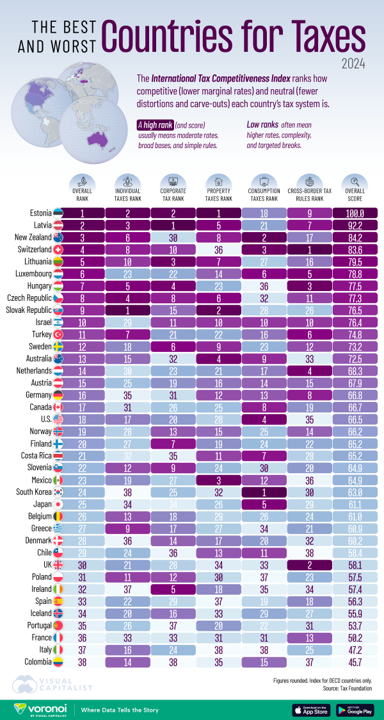
Estonia Tops Global Tax Competitiveness Ranking, Major Economies Lag

Global adoption of electrified vehicles has surged, with EVs, hybrids and plug-in hybrids making up 43% of global auto sales in early 2025 compared with just 9% in 2019, signalling the fastest transformation in the car industry for a century. Traditional combustion engines, which once dominated with over 90% of sales, now account for only 57%, reflecting tighter emissions rules, green consumer demand, and firms’ commitments to phase out petrol models. China leads the global EV market with 57% of BEV sales thanks to scale, state incentives, and battery dominance, while Europe (22%) and the US (12%) lag behind. Hybrids, meanwhile, have grown from 6% to 21% of sales, acting as a bridge technology for consumers not yet ready to fully commit to battery electrics.

Chart of the Week
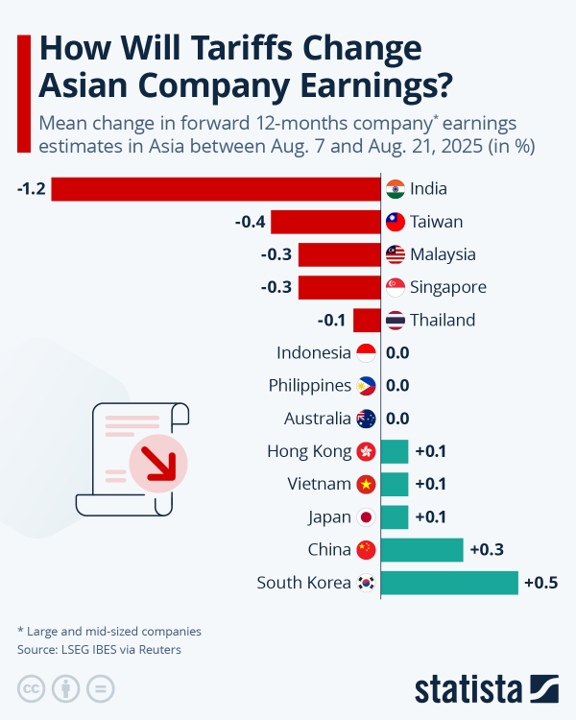
Tariffs Reshape Asian Company Earnings Forecasts

Recent U.S. tariff hikes have led to downgraded earnings forecasts across several Asian economies, with India hit hardest as its large and mid-sized firms are expected to earn 1.2% less over the next year under new 50% duties. Other countries including Taiwan, Malaysia, Singapore, and Thailand also saw cuts, facing tariffs between 10% and 20% on goods that make up a notable share of U.S. imports. In contrast, nations such as Australia, Indonesia, and the Philippines were less affected due to their smaller export share to the U.S., while China, Vietnam, Japan, and South Korea even received upgrades thanks to trade deals, tariff exemptions, or temporary truces with Washington. The divergence highlights how tariff structures and negotiated agreements can significantly shape corporate earnings trajectories across the region.

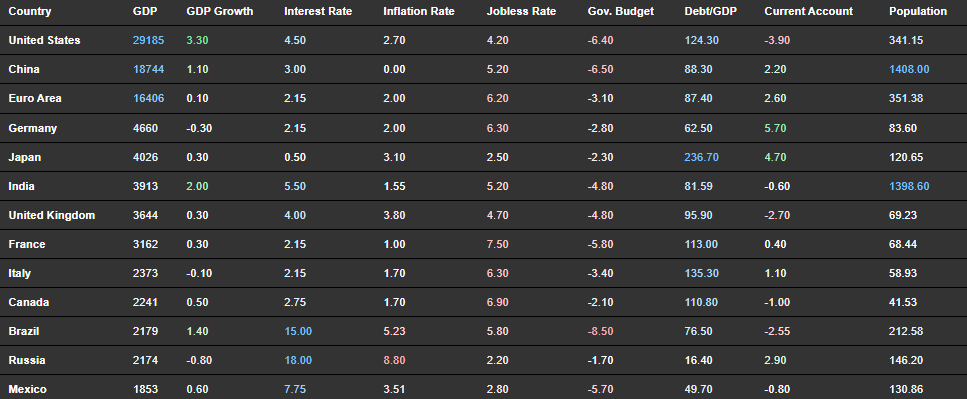
Macroeconomic Data

Whenever you're ready there is one way I can help you.

If you or your child are looking to Boost your A level Economics Grades in under 30 days, I'd recommend starting with an all-in-one support network where you get 24/7 access to a SuperTutor:

Join EdGenie 🧞‍♂️: Transform your A-Level Economics essays and exam marks (genuinely) with our comprehensive on-demand learning platform. This carefully curated course blends engaging content with effective exam techniques, the same ones that have empowered over 1,000 of my students to achieve an A or A* over the last 13 years. 
A huge thanks for hopping on board EdGenie's Wednesday Wisdoms newsletter! 
I'm Emre, and I've got a big goal - to make A* education accessible to all A-level students.
And it Starts With You!

Emre Aksahin
Chief Learning Officer at Edgenie